
We recently turned to a book we had long set aside—Alexander Stubb’s The Triangle of Power. The current Finnish President has written an engaging work, yet our reflection here is less about the book itself than about a particular perspective it raises, one that has given us pause.
Stubb presents a view common in Western discourse:
that the post-Cold War liberal international order, founded on rules and multilateralism, was a force for global peace and prosperity, and that its restoration—or preservation, depending on one’s vantage point—is a worthy aspiration.
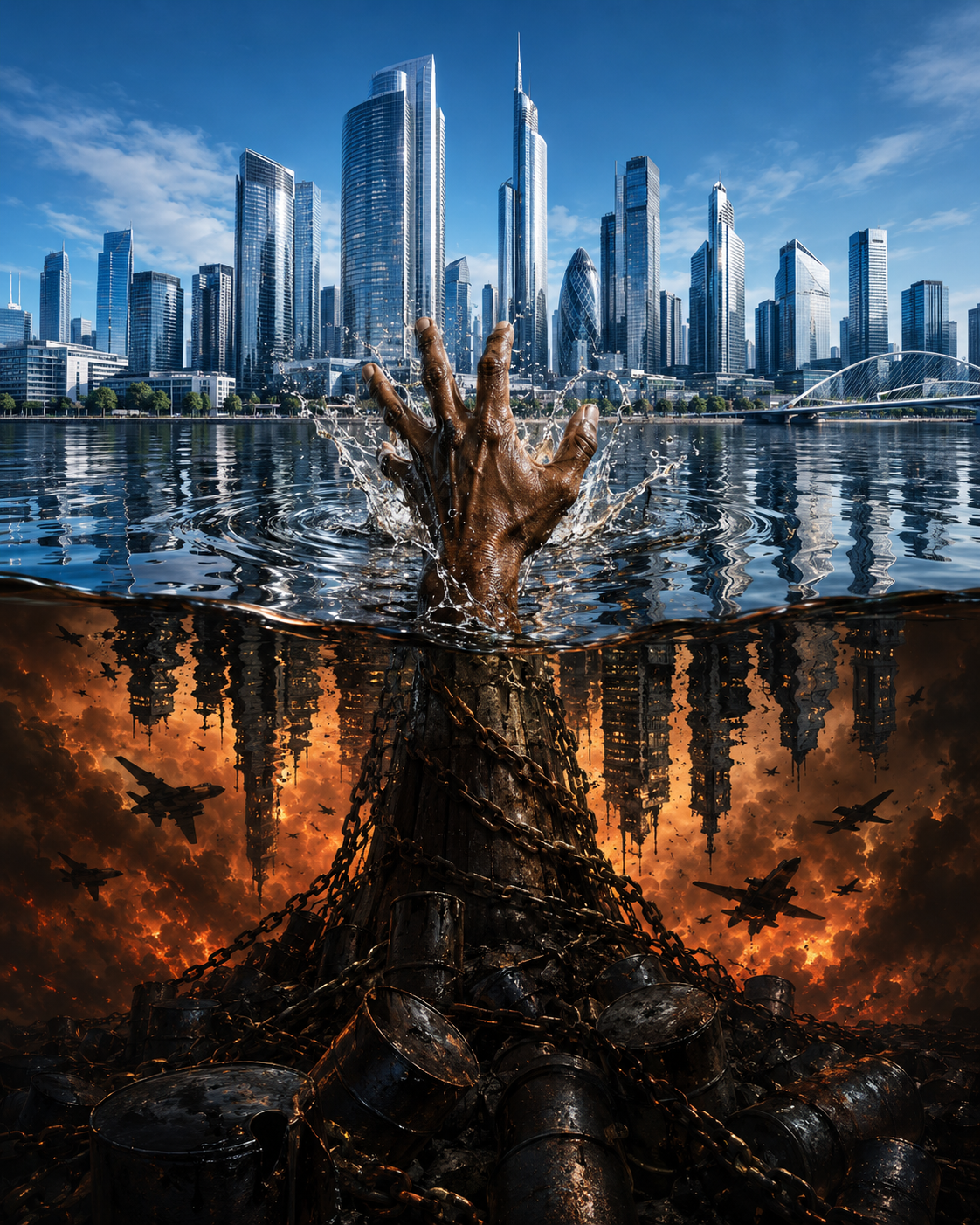 This is an idea we find steeped in hypocrisy and willful blindness. For what that order truly represented was a system engineered by the United States and calibrated to serve its own interests and that of Europe, wherein any nation willing to dance to the West’s tune was sheltered, while any that dared deviate was disciplined.
Consider the demographics: Europe, comprising less than 15 % of the world’s population, had secured its outsized advantages through centuries of colonial extraction at the expense of Africa and Asia. The post-Cold War order allowed these advantages to be locked in, even as the rest of the world struggled toward emancipation. Militarily, Europe emerged from the Second World War enfeebled and dependent, relying almost entirely on American security guarantees. But in exchange, Europe furnished the United States with diplomatic legitimacy and territorial staging grounds—and, crucially, a shield against accountability. Together, they acquired the latitude to bend, reinterpret, and, when necessary, rewrite the very rules they professed to uphold.
This is not hidden history. It is documented plainly in the records of Western institutions, official inquiries, and even the United Nations. Yet it is either ignored or deliberately obscured by those who propagate the liberal order myth. When the West wished to act, international law was contorted or cast aside. In 1999, NATO bombed Yugoslavia for seventy-eight days without Security Council authorization—an intervention the Independent International Commission on Kosovo famously deemed “illegal but legitimate.” In 2003, the United States and Britain invaded Iraq without a second UN resolution; Secretary-General Kofi Annan declared the action “not in conformity with the UN Charter” and, from the Charter’s perspective, illegal. In Libya in 2011, NATO twisted UN Security Council Resolution 1973—which authorized “all necessary measures” to protect civilians—into a mandate for regime change, bombing government forces and enabling rebel victory. Muammar Gaddafi fell; Libya descended into failed-state chaos. No sanctions followed. No prosecutors convened. No consequences attached to those who ordered the war.
The pattern continued. In Syria in 2017 and 2018, the United States, Britain, and France launched missile strikes without Council authorization. In 2020, the UN Special Rapporteur on extrajudicial executions ruled that the US drone killing of Iranian General Qasem Soleimani was “unlawful and arbitrary under international law”; Iraq itself condemned the strike as a violation of its sovereignty. Only the US intervention in Afghanistan post-9/11 might credibly claim self-defense under the UN Charter—but none of the others can muster even that slender justification.
The same indulgence extended to human rights violations. After 9/11, the CIA ran secret prisons, employed waterboarding and other widely recognized torture methods, and held detainees for years without charge at Guantánamo Bay. Europe was no passive observer; it actively collaborated. The European Court of Human Rights later confirmed that Poland, Lithuania, and Romania hosted CIA black sites and facilitated rendition. On drone warfare, the West again granted itself liberties it would never countenance in others.
The catalogue is long, and these are only the cases with direct evidence. There are numerous other incidents where the Western hand is visible but conveniently forgotten when condemning Russian, Chinese, or Iranian transgressions. The most recent illustration of such duplicity is the United States’ aggressive posture toward Iran.
Thus, the post-Cold War order functioned as follows: one state wielded overwhelming power at the “end of history,” and Europe, in subjugation to that power, secured its own privileged position in return—providing diplomatic cover, territory, and legitimacy. The arrangement served the West above all else. What figures like Alexander Stubb and other Western defenders now fear is that the rest of the world has awakened to this truth and is beginning to challenge the status quo.
Europe can no longer furnish legitimacy and diplomatic cover without scrutiny; the United States can no longer deploy military force without accountability. The 85 percent of humanity that was sidelined has come into its own power. The emerging multipolar order will no longer tolerate the façade of multilateralism when it consistently subordinates the interests of the many to the privileges of the few.